Bruce Cockburn received an induction into the Folk Music Walk of Fame in Ottawa, Ontario. Submitted by Nancy Bouwma.
Comments and speeches by Bruce Cockburn, concerning awards by date:
Canadian singer/songwriter Bruce Cockburn was recently the first recipient of the Global Visions Festival Artist Award for "demonstrating a long-term dedication to creating a vision of a more just world".
STATEMENT ON BEHALF OF LUBICON INDIAN NATION CHIEF BERNARD OMINAYAK TO BRUCE COCKBURN, Friday, January 27, 1995
I'm sorry I can't be here tonight personally but I want to congratulate you on receiving the first annual Global Visions Artist award. It's an honour you've earned and one you deserve.
Last year Maureen Littlejohn wrote in Network Magazine that part of the reason for your enduring career is your ability to infuse your "music with a conscience -- an inherent sense of what (you) believe to be right and wrong". You not only influence others through your music but you raise the profile of social and environmental issues through your interviews and your appeal to your listeners to get involved.
Your long-term commitment to Aboriginal issues, both through your music and your actions, is well-known. What may not be as well- known is the effect your commitment has on others.
As a small society surrounded by powerful, unprincipled enemies it's easy to feel isolated and alone. In addition to the impact your message has on others your continuing support sends an important message to the Lubicon people that we're not alone -- that there are people in the outside world who care what happens to us.
The Lubicon people, therefore, want to thank you for your concern, your support and your friendship.
We are pleased to offer you this Dreamcatcher as a symbol of our common dream for a more just world.
(Sharon Venne to elaborate in a couple of sentences the symbolism of the Dreamcatcher.)
BRUCE COCKBURN'S COMMENTS AT GLOBAL VISIONS FESTIVAL AWARD CEREMONY, January 27, 1995
When you look at the broad issue of justice for Indigenous Peoples, the picture is so large that it's hard to take it all in. Even when you narrow the focus to North America that's true. It's useful therefore to look for paradigms. Sadly, there is no situation which captures in microcosm the elements of the Native struggle better than that of the Lubicon Cree.
Colonialism, the paternalism of 19th century European thinking, the rush to settle and "civilize"; have given way to cynical buck-passing by Federal and Provincial Governments, to the playing off by unscrupulous industrialists of northern non-Native and Native communities against each other, even wedges driven into the Native community itself. It's hard to be a government person working for the transnationals of today, in this country. Recalcitrant Natives are sitting on valuable resources (in effect, on your opportunity for advancement). You don't want to pay them a fair price and you can't just kill `em like they do in some Asian and Latin American nations. They can read and write and use computers so you can't screw them with phoney legalities like in the old days. So what to do? It's a challenge to the ingenuity of the exploiter.
Of course, Canada, Alberta, Unocal and Daishowa can afford to buy LOTS of ingenuity.
I submit that those of us who care about such things as honour, justice and compassion have to keep the pressure on these folks until they are forced to exhaust themselves hunting for the next move.
You can find a version of this scenario in almost every part of North America -- though few are as urgent as the one the Lubicons find themselves in. Some of us have used the phrase "Brazil of the North" with reference to Alberta, and it's all too applicable. When I look at the Lubicon, I see what could be the "Nicaragua of the North" and I'm afraid, and I'm outraged, and I want to fix this, and I hope you folks who have a heart and a conscience will stand up and make it happen.
-- from Bruce's acceptance comments upon becoming the first recipient of the Global Visions Festival Artist Award on January 31, 1995.
When I came here in the fall of '64, there were exciting times unfolding. Being 19 is exciting in itself, though I'm pretty sure I didn't appreciate that then. Funny how older people are always telling you that "these are the best years of your life" and youth is spending half its time in a near suicidal state! But it was an exciting era. John Coltrane and Ornette Coleman were new! The Beat writers, Kerouac et al had started a wave that sent me and a lot of others spinning off in directions our parents found intensely disturbing. People were struggling to rectify the evil of holding one race superior to another. There was a WAR. America was bleeding itself dry in the rice fields and river deltas of a former French colony that had dared to turf out its European occupier and declare itself what it had always been, an ethnic and cultural community that did not require outsiders to give it direction.
As a foreign student, I was theoretically eligible for the draft, but way down the list of those most likely to be sent to Viet Nam. At that point they weren't drafting students at all. By the next "convocation" though, in autumn of '65, so many young people fallen that it was decided that there were too damn many students anyway, and why shouldn't they be made cannon fodder, too. They started with what they considered to be "non-essential" fields of study. What do you suppose was defined as non-essential? Why, ART of course - - including music, of course. Which is why my bass player friend, TJ from Harlem, dropped out of Berklee and enrolled in barber college. In the military view nobody's more essential than the barber. TJ was one fourth of a little rehearsal band which met on Saturdays and played through the day and night, trying to do "free jazz", Albert Ayler style - two basses, drums, and me on guitar and occasional poetic utterances, plus whoever felt like sitting in. It was never the same without him.
Some of us are a little slow on the uptake. I believed then, and for a long time after, that music was somehow above politics. That art could be held separate from the rest of human affairs, and that we wouldn't be touched by the mundane machinations of government.
There was plenty of evidence to the contrary: assassinations, conspiracies, intolerance of the lifestyles adopted by some of us, TJ's career change. I should have remembered McCarthy. It was a long time before I came to see the fallacy of that view. What I eventually learned through many adventures was this: politics is expression of humans trying to get along in a group. Any group bigger than one person. Every one of our interactions has a political component. If you don't believe me ask any of the women present.
You can choose to ignore this, but it won't go away. That was made clear when the Watergate scandal unleashed a whole string of revelations which showed me that everything I'd written off as wild-eyed conspiracy paranoia was true - that the FBI, for example, really did spy on students and probably murdered people. This relationship was made more transparent when I started travelling in the third world. In Latin America for instance, you can ignore politics if you want but it's liable to show up at your door with a machete one night and chop off your head, and your kids' too. That kind of thing can be found in lots of the world. It doesn't have to be that graphic.
Where do your strings and reeds come from? Where do they go when they die? Or your empty bottles? What powers your amplifiers and PAs and at what price? Where do the dyes in your clothing come from and how toxic are they? Who died prematurely of chemical poisoning so your cotton jeans or my silk jacket could remain affordable? Somebody makes decisions about all this. Usually not politicians, granted. It's usually boardroom types we never see. But government offers our main hope of directly influencing these kind of decisions, so we need to pay attention. The fact that we are artists doesn't absolve us from responsibility, nor does it lessen our complicity in how our way of living affects so many others.
I guess what I'm really talking about is community - the recognition that we're all in this world together, for better or worse. It's a world of wonders, a world of hurt. A world of love and beauty and a world of dark and unspeakable things. It's our world. There's nowhere else to go. In the `60s, the political choices of the leaders of the day affected when we went to school or to Viet Nam.
Today we're confronted by a broad range of problems which are connected to the very structures of life on the planet: DNA, our immune systems, our water, and the air that fills our lungs. We're faced with sweeping changes in the world's political and economic systems. The earth's climate is changing, both literally and figuratively. Tactics you learn today for navigating through the music business may need serious adjusting later on. The flow of money and goods from person to person and from company to company could be happening in a whole different way a few years from now. It's a wave of change we have to ride. We need to see it coming. We have to pay attention. There's nowhere else to go.
I'm aware I'm not talking to a roomful of political scientists or bioengineers. We're musicians and our natural contributions to the community of humans is more subtle. But most of us have been taught to value artistic integrity. Artistic integrity means telling the truth. Whatever truth each of us understands. The sharing of these truths is called communication, and communication makes community. Whether we share our experiences in an abstract form through the passion of our music or whether it's more concretely expressed in song lyrics isn't the issue. The issue is to share what we know, our discoveries and discomforts.
You're embarking on this academic enterprise to acquire tools - tools that will allow you to be better communicators - better sharers of experience. How you use those tools is your choice. There are lots of different ways to go at it and nobody can tell you what's the right one or the wrong one. It's not about whether you play guitar or trombone; whether you construct 12-bar blues or 12-tone rows. It's not about whether you play dozens of benefit concerts or sound off about one cause or another. You've got to do what's given to you to do. Remember, though, that if you say and do nothing, that's a vote for the status quo. It's necessary to be mindful of the interconnectedness of things.
Lakota people, whom our history books call the Sioux, have a phrase that they use in their prayers - "MITAKUYE OYASIN" - all my relations - we are all each other's relation, from the rocks and grasses to the smoked-out city scapes, from the most primitive organism wriggling on a microscope slide to the most cerebral artist or philosopher. No matter how common the thing you're doing, it has an effect. No matter how esoteric and outside the musical ideal you're chasing, somewhere something in the world is resonating to its sounds. We must not be afraid to love. We must not be afraid to vote. Each of us must follow our own muse. Each of us must consider our effect on those around us. Some of you might not be used to thinking this way, but it's really simple. While you're pursuing your art or learning to teach, keep your eyes and ears open to what's going on. That's what peripheral vision is for. Don't be afraid to take on social or environmental issues. That involvement won't dry up your music - it will ground it and inject it with fire. You'll learn how to balance your energy and time as you go. We don't all have to focus on the same things. There are plenty of issues to go around. Land mines, the quality of life for inner city folks, loss of the ozone layer, the treatment of migrant workers, the depletion of the Earth's resources, social atrocities like the School of the Americas - it's an endless list. Endless but not overwhelming. Just pick one you relate to and kick ass.
This is a convocation. That word comes form Latin. It means a calling together. I'm calling you to be together, within yourselves and with each other. We need each other. We need to pay attention. But man, never let anyone convince you that music is an expendable thing - that what you do is not important. Without music there's no culture and without culture, life is impossible. And don't let me hear about any of you signing up for barber college when the going gets tough. It's been done. Good luck. God bless you and may your road be smooth and well lit.
- Bruce Cockburn, September 5, 1997
-- Bruce's Acceptance Speech, Berklee School of Music Honorary Doctorate, September 5, 1997.
I'm deeply honoured to be the recipient of this doctorate! I've been trying to develop as an artist and a human being [all] these many years and it's extremely gratifying to have some[one] notice these small efforts - to offer this expression of solidarity.
All of the other being honoured here today are better speakers than I am, but I've been asked to say something too and I welcome this chance to share time and space and some thoughts and observations with you all.
You're about to go out into the world, as they say. You're getting ready to go out and be citizens of this country and this planet. That's an exciting position to be in. A little scary, maybe more than a little, but exciting. Your point of view is going to change with the experiences that come your way but I hope the sense of adventure stays with you always.
My own point of view has changed a lot through the adventure and misadventures that I've encountered. I like to think I've learned something, even if at times it only seems to be a recognition of how little I know. I'm a lot less disdainful of my fellow humans-a lot more sympathetic than I was in my 20's. I'm more hopeful, at least on a spiritual level about our prospects as individual souls growing toward a sense of our place in the grand scheme of things. And I guess I have to admit I'm more hopeful about our ability, as individuals, to affect the course of things around us.
I want to tell you something about that hope, but first it's necessary to establish the context in which that hope is found, or more accurately, the field against which it's found. The world is a mess! There was a very popular traveling preacher back in the 20s in the southern US. He recorded a sermon hich had as its refrain, "This old world's in a hell-of-a fix." That was back then…..
One attitude of mine, which has not been transformed, over the years, except perhaps to be deepened some, is a certain skepticism concerning human institutions. We are a social creature, but how we manage to complicate life with our attempts at establishing the perfect social structure!
We set up institutions to free us-systems of worship, government, business-but somehow these institutions always seem to cone to be about power. We give them a little and they want more. Churches and governments and armies and police and corporate boards of directors all have their legitimate and necessary rules, but it doesn't take much of a shove to tip the balance from social order [to] New World Order.
One of the important attributes of institutional power is that it wants to get bigger-to draw more power unto itself. This is a kind of metaphysical property which has only partly to do with careers and profits, though it's often manifested around those things. It seems to be a force of nature, like inertia or gravity.
This old world's in a hell-of-a fix…..
Sometimes I look around and I feel like we're on an elevator falling faster and faster, propelled by that particular gravity. Everything wants to eat everything else.
People in uniform do the bidding of governments acting in the interest of transnational business disguised as somebody's religious imperative. I have personal friends in all these camps and I'm continually mystified at how someone can be a person of sensibility, of conscious even, and still be able to play ball with this system.
Globalization is the buzzword of the day. The shift of political power from nation states, which, however distorted the connection, are about community, to corporate entities answerable only to their boards of directors, is in full swing. Picture a big fat fist closing around the world, saying its bringing order and benefits to all. But instead of creating a true and useful order, what squeezes out between the tightening fingers in chaos-the entropic assertion of tribal distinctness, exploited for the benefit of a tiny minority-ethnic cleansing, a vicious little low intensity conflict here, food riots there, somebody's rights trampled one place, somebody's children slaughtering their peers somewhere else, bankers and investors doing end runs around the law….
We've only barely started to see the effects of environmental degradation-hormone disruptor, ozone depletion, desertification, the shrinking supply of safe water!
This old world's in a hell-of-a fix and we have to deal with it, you and me, but mainly you because I'll likely be out of here before we really hit bottom.
I look around at the amazing beauty, the incredible balance of the world God made us part of, and I see how it's getting trashed and I want to cry out at somebody: STOP KILLING MY WORLD! YOU'RE KILLING MY WORLD AND YOU'RE MAKING ME HATE AND I HATE YOU FOR MAKING ME HATE... but I don't say these things, who do I say them to?
Maybe some of you feel this way too. Maybe some of you want to scream in rage. Maybe some want to try and shut it all out.
Some of the people in the aforementioned institutions, maybe many of them even, may convince themselves they're doing good. Sometimes they even do good …with one hand…but the other hand doesn't notice.
Our own government, last year pressing for a comprehensive ban on antipersonnel mines, this year supporting the spraying of cluster-bombs, essentially the same kind of weapon, all over Yugoslavia! What are they thinking?
What are they thinking when they curry the favour of a murdering 3rd World despot because we supposedly want his business?…Business that consists of exploiting his cheap labour force, kept affordable by violence, and so depriving our own working people of jobs. And when some of us protest this unconsciousable toadying what does our government do? It calls out the forces of "law and order" to suppress this dissent, terrorizing young college women with gratuitous strip searches among other things, nothing must interfere with the flow of so-called trade.
You history students will know that, while I'm speaking of the very current APEC fiasco, there's a long tradition in Canada of calling out the troops whenever social protest looks like it might jeopardize the profits.
Pol Pot kills a million people and we rightly condemn him . Suharto kills a million people and we invite him to lunch. Milosevi... we attack him and in so doing consolidate his power over the Serbs and risk starting a 3rd world war...!
We're letting the Lubicon Cree die out, withholding justice from them which would be dead simple to offer.
Statistically a lot of places are worse than Canada our home and formerly native land, but there's lots that needs addressing around here. There's no justification for the smugness one sometimes encounters.
Okay so you're thinking, "I'm celebrating my graduation and I don't know if I want to hear all this right now" but bear with me- the hope part is coming back.
This old world is in a hell-of-a-fix and we have to fix it. Soon. We'll never fix all of it, so don't be disappointed, but we can sure make it better than it is. To do that we need to identify the problems. And we need to have some idea of where we stand in relation to these problems.
It's no good slipping into an us-and-them way of thinking. That's what leads to wars and slaughters and strip searches. And what allows a person to let their greed run away with them at the expense of those around them.
There's no us-and-them. There's only us.
Greed twists eternal in the human heart. Greed and fear. We're all capable of the rationalization and compromise, which permit the existence of the evils we see. There's somebody's famous saying,..."I've seen the enemy and he is us." There's a clue in there somewhere.
Hearts, like teeth and the rest of our bodies, have to be cleaned regularly. We can do this with prayer, with meditation, or like the ancient Egyptian priests of Ra we can "go outside in the morning and wash our hearts with laughter" as it says in the Book of the Dead. But we have to remember to put on our sunscreen.
This may sound corny but it's a great and mighty truth: along with our capacity for all the nasty stuff, we have the antibody in our systems. Each of us does. The antibody against the greed virus and the fear virus and all the rest is love. Love for ourselves, not vanity, but tolerance and patience-love for our friends who screw up sometimes and let us down - Love for people we can't see but might meet someday-and the hard one - Love for those who threaten us or do us harm.
The concept is perfectly simple. Getting to it as a practical reality isn't always that easy. This is where the heart cleaning comes in. Love requires a lot of letting go. Sometimes letting go of things we hold dear.
All this is kind of obvious, but it's so important it bears voicing aloud. The consequences of love's absence are everywhere, evidence: in Littleton, Colorado, in Kosovo, in the swelling numbers of homeless in our major cities.
Sometimes I think the flawed institutions with which we surround ourselves are a mirror, an externalization of the things we carry in our hearts that we don't want to see. Or things we are afraid of ourselves. That's okay. It's a matter of proportion. These institutions are there to help us-to serve us-the big US- the US that has no THEM. If they don't serve the big US we have to change them so they do.
So this is my assignment to you, for some of you perhaps, the last assignment of your academic careers. Go out and love. Love yourselves. Love each other. Love the earth. Love Truth. God is in all these things. Love God. Even love the institutions [if] they let you. But be wary of that power thing-there's no love in that. They'll offer you a crutch but they'll take your feet so you become dependent on it. Love your own two feet. Stand on them. I'll do the same. And after awhile we'll figure out how to dance, as well.
[Note: Use this link to view this speech written in Bruce's own hand.]
-- Bruce's Convocation Speech given at St. Thomas University, 10 May 1999. Submitted to the project by Wilfred Langmaid.
It's "a great honour," Cockburn said in a statement. "Somehow it feels like it's too soon."
-- from Jam Music, Cockburn to Enter Canadian Music Hall of Fame, October 18, 2000, by Mike Ross.
[Interviewer is Andrew Flynn]
Andrew Flynn: Hi Bruce. Congratulations on the Hall of Fame award. Does this mean you're officially old now?
BC: That's the fear. But I think I'm over it.
AF: It has been 31 years since your first album, that's got to come as somewhat of a shock.
BC: I think it was when I first started to think about it. But I'm kind of used to the notion now. You know I look at B.B. King and John Lee Hooker, guys who have been doing it twice as long at least and they're still going.
AF: How did you react when you heard about the Hall of Fame induction? It is a late-in-the-career honour; you can't give it to a newcomer.
BC: No, I guess not, not unless the newcomer is kind of like James Dean and gets it over with fast.
AF: I was going to say, you know, usually you don't get it until you're dead...
BC: There is that. But in fact there do seem to be a number of living recipients. The fear was - and it did occasion some fear - that it's not so much physical as it is creative death. Does this mean I'm supposed to stop now? Things are supposed to freeze where they are. That's what I said I was getting over, it's really - I had to adjust my thinking slightly because I never gave Hall of Fame a thought about anybody. That's not how I think about things. I was aware of people being inducted into halls of fame of various sorts, sports and music and otherwise, engineering, whatever. But it was not something that I ever gave any serious thought to the implications of.
AF: It must be nice to be recognized in the context of the Junos. They've essentially been around as long as you have.
BC: Yes, slightly less long. I was at the first one. But the last time I was at the Junos was 1981. So I actually have to go to this one. Which is another big thing about getting in the Hall of Fame - you have to show up.
AF: Why have you not shown up?
BC: I've never been interested. When it first started it was so naive and innocent and so unglamorous. It was just a bunch of music people in a room in a convention hall somewhere in some hotel and it was all kind of in-house. It was the business people getting together and patting themselves on the backs around the artists.
But that's what it's about for me. They were able to, in the interests of business, move it into a performance kind of context and sell tickets and have it on TV and that, from a publicity point of view, was a smart move. But from the point of view of creating public interest in the music, it has nothing much to do with me as far as I can see. I've never been particularly interested in involving myself in it but when you get the Hall of Fame you've got to go. I think for the people who do believe in it the honour is real and therefore it's real for me because they really mean it.
AF: What do you think the importance of something like the Juno awards is? Does the Canadian music industry need something like that?
BC: I'm not sure if it needs exactly that, but it needs something. These days in order to be noticed in the world you need to be on TV. It serves that purpose for sure.
AF: I guess the awards do serve an important purpose still, in letting Canadians know what is Canadian. The lines get blurred on video stations; there's no Canadian content label that pops up on a song on MuchMusic.
BC: No, and for Alanis or Nelly Furtado or anyone who fits in the more mainstream styles of music it is worth making that point.
AF: Do you think we'll ever get away from this concern about how Canadians stack up against the rest of the world?
BC: Oh, probably not, not for a long time. Because we're always going to be compelled to measure ourselves by the United States, which is what I think you mean by the rest of the world. At this point in history anyway. That may change someday but we're sort of so much in the shadow of the U.S., we've always had this, on the one hand, envy and naturally with that, on the other hand, resentment.
AF: And the terrible irony of that is that no one in the U.S knows or cares really whether you're Canadian or not.
BC: No. And there are waves of that too, like with the Mackenzie Brothers hits, it was cool to be Canadian, even if they were like the new Amos 'n' Andy. In Ani DiFranco's anti-gun song she talks about gathering her friends and moving to Canada because there is a perception that this is a kinder, gentler place than the U.S., and in some ways it is.
AF: Do you feel like you deserve a lifetime achievement award yet?
BC:I don't think deserve enters into it for me, it's not my job to decide what I deserve.
AF: What I mean by that is do you feel that you've achieved something extraordinary?
BC: No, I don't feel like I'm in a position to stop, let's put it that way. I can look back and I can think yeah there were some good songs and that album's good, that album I don't like so much. I have a perspective on all of that stuff that includes appreciating the value of some of it at least.
AF: In musical terms.
BC: Yeah.
AF: What about in the larger picture, because you've always had a political bent to what you've done; you've always done something with a purpose.
BC: The purpose is to create good art, that's my purpose. What it happens to be about depends on what I've experienced during the period that produces the art and I think that everything - I think we've probably had this conversation before, but at the risk of repeating myself - everything in life is suitable subject matter. That's where I come from with it. I don't sit down thinking I must address X, Y or Z issue. The fact that I have a conscience as a human being and the fact that I feel things that I encounter touch my heart and end up being distilled through the creative process into songs is what's led to the perception of me as a guy with an agenda in the songs. But it isn't really like that - the agenda's after the fact. The agenda is to be truthful whatever that means and to try to have something to say. There's no point in having words if they don't say anything I figure. Why bother then.
AF: Sure, you may just be applying what you see and feel and hear in your daily life, but I think people need sometimes to identify with somebody who's got an opinion about something.
BC: I agree.
AF: If I Had a Rocket Launcher expresses ...
BC: Yes, it's relatively unambiguous. Yes, I think you're right, I think it makes a difference when someone who's in a position to be heard in public makes a statement in public, that is different from how most people are able to make statements and therefore it's kind of received in a different way.
AF: Exactly and you must feel, if not pride, then some satisfaction in the fact that that's been recognized and that people have listened to what you have to say and say yeah, I agree with Bruce. And heck, I like his music too.
BC: Yeah, I guess I'd have to admit to feeling that I think that's true. It's an awesome thing, as a matter of fact, and I'm not even sure that satisfaction is the word. It goes beyond that. I am very moved when I find that someone's been touched by one of the songs deeply enough for it to have had an effect on their life some way.
It's satisfying and gratifying to hear that people like what I do and to have people show up at shows and buy records and what not, as an indication of the fact that they like what I do. But once in a while you get some feedback that suggests it's gone further than that. That a particular song has touched somebody's life in a deeper way and that's sort of scary at the same time as it's very positive. Because it's not something I set out do in a concrete way. You can't work on the expectation that that's going to happen.
-- from "Interview: Bruce Cockburn", for Spotlight.CA, by Andrew Flynn, 28 February 2001.
"I've had time to reflect on the Hall of Fame thing, time to get over my fear of taxidermy. That was a very big part of my initial response. Some of my fellow inductees are still alive, some aren't. Some are active, some aren't. Some are doing living things, others are repeating what they've already done. That's the category I don't want to find myself in."
After 24 albums - 30 if you count foreign pressings, compilations, live packages and promotional recordings - in 30 years, Bruce has no intention of slowing down, living on his laurels.
"For one thing, I can't afford to. You'd think after all those records and a tour every couple of years I'd have little to worry about financially. Then April comes, and the tax man takes away half of what I've got."
Bruce wonders whether his induction will create the impression that his life's work is done.
"It's a compliment, of course, a great honour," he says. "A lot of people take this stuff really seriously and put great stock in it, and good for them. They're saying something really nice to me and about me by inducting me, and that's great, I appreciate it.
But I'll never stop what I'm doing. I'm concerned about age as a human being facing certain prospects, though I'm not yet aching in the places where I used to play, as Leonard (Cohen) says. But, as an artist, I'm not concerned. If age means shutting down, closing the heart, relying on past habits to get you through, it'll be a problem for any kind of creative work. So far that hasn't been the case. I feel as if I'm learning at the same rate as I always have, but I'm more aware of it now, and able to appreciate it more.
My models for graceful aging are guys like John Lee Hooker and Mississippi John Hurt, who never stop working till they drop. Eventually time is going to get everyone, but in the meantime, they stay out there, doing their thing - out of necessity, to a degree, as I fully expect to be doing - and just getting better as musicians and as human beings. You don't have to stop maturing just because you become mature."
As for taking his place in the Canadian music pantheon, Bruce is a little reluctant, but not unprepared
"Awards and honours like this always invite reflection, looking back, and I've never been inclined to do that. But when I do, I'm reminded that, yeah, some of those songs are pretty good. I guess I'll always have something to play, even if the writing stops. I shouldn't write them off because they're old. I never planned for my songs to be passed along or studied. I'm always aware that there's someone listening at the other end of the process, and so I want to make a song intelligible to that imagined audience. Beyond that, I don't think about crafting songs so that they stick around in the general repertoire. I just want to do what I do as well as I can, and now I have the faith that there are people out there who appreciate it.
One of the pieces of advice I have for young songwriters, after I've determined that they're writing from the heart, that they're working on some spiritual exercise, is this: If your bottom line is that when all else fails, you'll be out there in the subway singing your songs, then we can talk. But if it doesn't mean that much to you, I don't know how I can help. That's still my bottom line. Even if no-one's listening, and provided my fingers are still working, I'll be out there."
-- from "Why Bruce Matters Now", The Toronto Star, March 3, 2001, by Greg Quill.
"It seemed like you're supposed to be dead or something to be in the Hall Of Fame -- and I didn't feel that dead," joked Cockburn, 55, this week about when he first found out. "It kind of took me aback slightly -- it's a great honour at the same time, so the feelings were mixed. I was slightly uncomfortable because of that but I've kind of gotten over that now. It's just a nice thing."
"I'm definitely nervous about having to get up and speak in front of people, because it's not really what I like to do," says Cockburn. "And I'm excited to see what kind of fuss that they'll make, it might well be that I get my 10 minutes of fame."
"And I'm looking forward to Sarah Harmer, I'm a big fan of her album, and Jann Arden and the Barenaked Ladies and Terri Clark, they're all going to sing and it's great. People are doing this because they want to and it's kind of shocking to me and very pleasant."
--from "Bruce Humbled by Hall of Fame, Induction a thrill for icon Bruce Cockburn", Toronto Sun, March 3, 2001, by Jane Stevenson.
"Neither do I," he says. "I mean the Hall of Fame is a pretty big deal, but there's also a sense that I'm not quite dead enough to be in a Hall of Fame." "But here's the industry saying, 'Hey, what a great guy, ladies and gentlemen, Mister Showbiz, Bruce Cockburn. . . ." "Ta-dah! Out waving his cane."
-- from "The Witness", Saturday Night Online, March 3, 2001, by Bill Cameron.
Q: What does this Juno award mean to you?
BC: It's an honour, obviously, and I don't take it lightly. But I'm not attached to awards, I don't operate for awards or rewards, the reward for me is the writing of the song, when I get a song out of the air or wherever it comes from I feel rewarded that it exists and that's the most satisfying thing I do in terms of work, creativity and all. Everything that happens after that is kind of a mixture of business and pleasure and necessity. I mean the Hall of Fame is a pretty big deal, but there's also a sense that I'm not quite dead enough to be in the Hall of Fame. On TV last night they announced the Grammy Hall of Fame people for this year. Michael Jackson going into it for the second time, and Sting? I'm not sure, but it was people who had formerly been in bands, Jackson got in previously as part of the Jackson Five and again as himself, and whoever the other artist was the same thing, he'd been in a band, so okay, that kind of puts it in a different light, if you can be in it twice obviously you don't have to be dead.
-- from "The Cockburn Transcripts", Saturday Night-Online, March 2001.
BC: "The mayor wouldn't confess what it was exactly for -- or what lock it fits."
Discussing the honor of receiving the Canadian Music Hall of Fame
BC: "I'm not particularly given to looking back."
"I'm not particularly interested in the kind of measurements that awards represent. I know when I've gotten to somewhere where it feels like I've achieved something, creatively speaking, and in every case that I've felt like that, it was also evident, at the same moment, that it was necessary to keep moving. "You can never sit around and say, 'I've done it now,' unless you just want to stop and literally retire, which I guess is a viable option if you feel like that, but I don't."
"I don't really think awards are worth anything, other than PR," he continues. "There's no question they have value that way, but that being said, a lot of people do put great stock in these things and a bunch of those people have decided they want to include me in the Hall of Fame and that's a nice thing. That's a complimentary thing and an honour."
Earlier, and more seriously, he had said
"Everything in life is about growth. Growth is a continuing process that I personally believe doesn't stop when we die. Death is a major graduation point as I see it. That'll be the big one. "The Juno Hall Of Fame may suggest death in an oblique sort of way," he laughed, "but it just isn't the same thing."
-- from "In Praise of Bruceness", Ottawa Citizen, March 4, 2001, by Craig MacInnis.
"I don't spend very much time reflecting on what I've done. I'm not that interested in that, to be honest. I'd rather think about what I'm going to do next.
Of course it's complementary to be honoured in that way. [referring to the Hall of Fame induction] and I've had maybe more than my share of that kind of stuff, or at least more than I would have ever expected to have.
But at the same time it doesn't translate, for instance, into getting my records played in Canada on the radio -- nobody does that ...
I get played all over the United States but I don't get played in my own country -- what's that? I don't spend a lot of time thinking about that either, but it's very noticeable. When I play for an audience (in the U.S.) and they know all the stuff and I play for an audience in Canada and they haven't heard it, there's a very noticeable difference there in the response that you get ..."
"In some ways I'd rather have less honour and more radio play, [he laughs.] But the honour is nice, too."
-- from: "Music Living in a Dangerous Time", Calgary Sun, March 28, 2002, by Mike Bell.
Over the years, I've been privileged to work with a number of great people and great organizations, chief among them USC Canada. Though my role is only more or less that of mouthpiece, that involvement has led to some great adventures, as well as the odd desperate moment, and now and then a song.
I've done what I can to help, but I feel like I've gained more than I've given - from the sense of having been in on something meaningful - from the opportunities to travel, to see things up close, to understand, more than I ever could have otherwise, the way things work.
I'm grateful to USC and I'm grateful to Friends for Peace for this chance to celebrate the work it does. Work which makes the hard lives of a lot of people just a little bit easier.
A few months ago I was standing near the Wailing Wall in Jerusalem, the City of Peace, and I was thinking, "There's never going to be any peace!" There, in that vortex of human spiritual hunger that is the Holy City, every shade of Christian, Arab and Jew, and who knows what else, can be seen. Must be seen is more like it, because everyone's out in their team uniform making sure no one can mistake them for each other. Side by side with the richness of history, the nobility of the beliefs subscribed to, stands the madness that tribalism and fear-of-the-other produce. Instant anger. Readiness to kill over whose approach to God is the more perfect. Each faith claiming to be one of peace.
A few years back, traveling in Mozambique in the aftermath of that country's 25-year civil war, I had the feeling that peace is the breathing space between bouts of war - that the natural state of humankind is conflict.
A casual glance at history, or a newspaper, will tend to bear that out.
Peace is about survival.
I look around at the world - the globalized world - the world where what goes around comes around - the world of the 6th Great Extinction. I wonder, how many species will we lose? And I cry for the passing of those that have gone, and those we can see disappearing before our eyes. Is this what Noah's flood looked like when it was just starting to rain?
If I were God surveying my beautifully and terribly balanced creation, Earth, what would I think of my pride and joy, humanity, who has taken my gift of life, of potential, and rendered it obscene with pathological greed, with the technology of destruction?
Would I be the Old Testament God, and in a cold rage turn my back and busy myself with new creations elsewhere in the multiverse? Would I be Kali, the Hindu goddess of destruction, aroused by the scent of so much death and pain to finish what humanity has started?
Humanity.
When I wrote "If I Had a Rocket Launcher" back in 1983, I was trying to catalogue and share how shocked I was to feel that I was willing to kill the Guatemalan soldiers who were perpetrating atrocities on the Mayan people among whom, as refugees, I found myself.
I felt that those soldiers had forfeited any claim to humanity and should be put down like rabid animals. I was wrong, of course. Far from forfeiting their humanity, they were expressing it. And so was I.
We use the word "humanity" to refer to an attitude of compassion, to refer to the study of esthetics, of ideas, but surely we are the greatest of liars! No species but ours makes war, slaughters its own, lays waste the Earth, poisons the air and water it needs to live.
A quick examination of any newspaper will show us men, and occasionally women, who commit unspeakable acts in the name of God, of country, of imperial hegemony. And they'd better have good reasons for these acts, because they are living examples of why humanity should be a failed genetic experiment! The things that get done horrify us, arouse our hatred and anger, but the perpetrators are us.
When we're gone, will there finally be peace?
I say these things not to incite despair, but to point out what we're up against when we campaign for a peaceful world. Our real opponent is the pathology that dwells in the human heart. For further proof, look at the numbers of us who are willing to die for war, in aid of whatever cause. How many are ready to die for peace? Some, for sure - the Christian Peacemaker Teams, and other courageous souls who show up here and there, but how many? When those of us who would die for peace outnumber those who would die for war, will we then have peace?
In the meantime though, we still must struggle on. At the very least, the effort to build a culture of peace may help to keep things from getting even worse.
If we are to make war on war, step one is to know the enemy. That is, to know that we are all broken. Nobody is holier than anyone else. It is in our brokenness, our scars, that we find common ground - grounds for compassion and love and forgiveness. It's in the light that shines through the broken places that we might, if we're lucky, find the way to where our fanciful definition of ourselves can be made reality!
Friends, even as we gather here in the name of Peace, we are at war. It's hard to imagine, for those of us who arrived after the end of WWII, who have never known a Canada whose troops were anything but peacekeepers. At least that was our image of ourselves. The men and women in uniform would have seen it differently. What they would call "peacekeeping," is too often an exercise in PR which really consists of putting our loved ones between belligerents whose intentions are far from peaceful. But right now, we're not even dealing with the pretense. So we must ask ourselves what is the ultimate meaning of this war.
Is it, as stated, to make Afghanistan safe for people to go about their lives free from the fear of organized violence? Is it the necessary prosecution of The War on Terror, Washington's name for the complex scenario which only tangentially involves an extended response to 9/11, but which seems to have at least as much to do with the Bush administration's fantasies of a Christian hegemony under a US flag?
I respect, admire - I love our Canadian men and women who are risking their lives for whatever it is! The million dollar question is, what is it?
If we're getting our kids killed for oil, for the frigging economy, then let's bring 'em home, and let's put those resources into the search for a sustainable future.
If we're engaged in a struggle against forces whose intent is to make the world safe for the subjugation of women, for the intolerance of any belief that differs from their particular reading of their particular scripture, then we have to say yes! We need to resist that. We need a world where we don't have to answer to some ideologue's frightened ego!
So - on a planet populated, maybe dominated by ideologues with frightened egos, we have to seek out that broken place in our hearts where the light comes through. Where we can hear the cry from the hearts of those who oppose us and address that cry.
There's nothing easy or simple about this. Whatever tools you've got - prayer, self-analysis, a body to put in the way of bullets, a fat donation to some organization working for social justice, whatever. Use it. Use it now and use it hard, for time is short!
Maybe we're done as a species, but maybe we're not. If we want a chance at a tolerable future for our children and grandchildren, it let's get on it!
I don't know how deserving I am of this. There are a lot of people who've given far more than I have. Some gave their lives. Some I've had the privilege to meet: Margaret Hassan, head of the Iraqi Red Cross, abducted and killed in Baghdad; the young man whose self-appointed task was to search out and document the dead victims of government repression and torture in El Salvador, whose storefront human rights office was bombed. But I'm grateful, and proud, to be part of this public testament to the side of the human heart that is not pathological. The side that loves, that holds beauty higher than fear. The side that hopes!
In Baghdad, as in all the zones of conflict I've been in, I was humbled and emboldened by the spirit the people showed - by the resilience and even capacity for joy in the face of hardship and chaos. If we can find that capacity in confronting the demons in our own hearts, we have a chance!
Thank you.
- transcription of this Ottawa Peace Award Speech by Bruce Cockburn submitted by Mark Austin, board member of USC Canada.
Isn’t ceremony a wonderful thing!
Ladies & Gentlemen,
It’s a great, and I have to say, unexpected honour to be here today to receive this degree. Unexpected because in all the thinking I’ve done about God, I never imagined any sort of public acknowledgement of it. Nor did I feel particularly qualified to carry the title, but that’s Grace, isn’t it? Comes at you out of nowhere and spins your life in new ways!
Grace: A couple of months ago I was doing a phone interview with a guy at a radio station in Madison, Wisconsin, and he asked me about a particular song on my most recent CD. The song is called Mystery. He quoted these lines: "Infinity always gives me vertigo, and fills me up with Grace." Then he asked me "How can you have vertigo and grace at the same time? Isn’t that a contradiction?" It took me a minute to realize that, for him, grace was about being a good dancer, or being able to do tricks on the balance beam. Never having been good at any of that sort of stuff, I have not had to be confused about what Grace means. I’m alive because of it. I’ve made a lot of music and had some great adventures because of it.
Grace is what we all need, whether we know it or not. We can, by virtue of great effort, expand our understanding of things, sometimes even expand our ability to do good in the world – but it doesn’t take much looking around to see the limits of even the best-intentioned human behaviour. Without that element of alignment with the flow of creation, the New Jerusalem remains out of reach. I mean, the people who founded Montreal believed they were building the New Jerusalem!
Some years ago I spent 5 weeks in Nepal, mostly visiting development projects supported by the Unitarian Service Committee of Canada. At the end of the trip we traveled to the region of Mt. Everest and spent days walking the steep trails through a magical landscape of flowering rhododendron trees, rivers rushing down deep canyons, frightening heights and beautiful sights. At every crossroads was a stone cairn built by pilgrims over centuries, each rock carved with prayers and carried to the spot from wherever they came from. By every building colourful prayer flags fluttered, the passing wind carrying their message to the ends of the earth. A landscape of devotion – charged with the energy of the Spirit.
As we ascended the path one morning, we met a small party of travelers coming down. An elderly couple who turned out to be American and some Sherpas. We stopped to chat. The old man told me he had left his teaching job at a seminary in the Midwest to come to Nepal 25 years earlier to bring the Gospel to its people. He was about to leave to return to the U.S. and was taking one last opportunity to appreciate the spectacular surroundings.
He proudly told me he had taught Robert Schuller, of Crystal Cathedral fame, but he was bitter and seemed diminished. He said that in 25 years he had not made a single convert. His words were, "These people don’t want to know about God."
I felt terrible for him, as he appeared so oblivious to the spiritual surroundings. He’d spent ¼ of a century not learning what he might have about God!
Because we are who and what we are, it’s almost impossible for us not to think tribally, to be judgmental of our neighbours, to feel that our approach to the things that matter, because it suits us, must also be appropriate for those around us.
I don’t think God is about that. It it’s true that love is the attribute of God that is supposed to have the greatest affect on us, how can it flower in a soil of divisiveness, false pride…fear of the other?
We all have our strengths and weaknesses. I can play guitar better than some people. Somebody else can run circles around me when it comes to math. Someone over there can wrestle, or grasp the patterns in the movement of subatomic particles. Some of us "get" our bodies really well. Others are more open to the Spirit. We all have our insights, and together we add up to a healthy organism.
That is, if we only look at the good things. We still carry the seeds of our destruction. In fact, it seems to me that this internal contradiction is also evident in the way we interface with the world. We, as a species, are in a race between our collective urge to self-destruct and our longing to feel that alignment with the cosmic flow I mentioned a minute ago. If we make life choices based on fear, or greed, or extreme self-interest, we are on the side of chaos and death. If we can grasp how inter-connected with each other and the rest of creation we are (and I’m not only thinking of the physical systems that give us life, but the spiritual spaces in and around us too) and make our choices based on that understanding, which I think we can call Love, then we serve the greater good without resorting to badges, and team uniforms, and hopefully, weapons.
We are heading into a time of tribulation. I’m not saying it’s the Tribulation, as some of our fundamentalist friends think. It’s not our job to second guess God. But tribulation none the less.
Massive change is upon the world. Massive and rapid.
In your lifetime you’ll experience the price of the industrial revolution. Changing climate, global epidemics, economies shattered by planetary warming and wars and pollution. A lot of people will be on the move in coming years, even more than at present. Those who are lucky enough to be able to stay where they are will feel the movement in the form of pressure on all systems, surrounded by the pain of other people’s upheaval.
You, who care enough about our relationship to the Divine to have committed to spending years studying it, will be given a special burden to bear.
That relationship, at least the traditional concept of it, doesn’t have much currency in the Western world, the popularity of Evangelical churches not withstanding. Between the dogmatism of fear-based fundamentalism and the Battlestar Galactica New-Aginess of Hollywood, down there in the cracks, there is room for the sharing of real understanding – of personal, experiential knowledge of God – of LOVE.
And that’s your mission, should you choose to accept it – to get that experience – to be fueled by that love, and to go forth and share the insights and the inspiration you have gained therefrom.
Don’t worry about making converts. If you go out there shining with the light of God and brimming with love it will be noticed. A door will be opened for the Spirit to walk through. Whether that Spirit gets discussed in Christian terms or not is not really material. It’s being awake to its presence that counts.
That is the beginning of a remedy for the pain of being alive in dark times, just as it’s the beginning of the healing of our not-so-well-carried-out stewardship of our Earth.
And look – we’re back to talking about Grace!
At the risk of taking too long here, I’d like to leave you with the lyrics of a song I wrote awhile back. It’s called The Light Goes On Forever.
Shaman clambers up the world-dream tree
looking for clues about what is to be.
Chants and trances give his spirit wings for flight.
Wings still shackled to history –
the chain of events ain’t broken so easily –
let me rest in the place of light.
Skull drum, skin stretched tight
sends out ripples in the gathering night.
The deepest darkness breeds the brightest light.
Music rising from the bones of saints,
from the pungent smell of sad sweet poems and paintings –
let me rest in the place light!
God waves a thought like you’d wave your hand
and the light goes on forever –
through the seasons and through the seas,
the light goes on forever –
through the burning and the seeding,
through the joining and the parting
the light goes on
forever…
Gypsy searches through the cards for truth.
Alchemist searches for eternal youth.
Human reaching almost makes it – but not quite –
and so strikes out at what the wind blows by.
You live and it hurts you, you give up you die –
let me rest in the place of light.
Fugitives in the time before the dawn,
backed up to the wall with weapons drawn,
like mounted nomads, always ready for a fight –
this creature that thinks and so can fake its own being –
lightless mind’s eye not much good for seeing
let me rest in the place of light!
God wave a thought like you’d wave your hand
And the light goes on forever.
Through the people and through the walls
the light goes on forever.
Through who obeys and who does not,
through who gets rich and who gets caught
the light goes on
forever.
Uptight lawyer on Damascus road
becomes a nexus where the light explodes…
concentrated – overpowering sight.
2-way whirlpool churning up all the time-
infinity stoops to touch the human mind.
Let me rest, in the place of light.
God waves a thought like you’d wave your hand
and the light goes on forever.
Through the buildings and through the hills
the light goes on forever.
Through the struggles and the games,
through the night’s empty door frame,
the light goes on
forever.
That’s it. Go with God.
Trust your dreams.
Thank you!
[direct link]
Ladies and Gentlemen, Sisters and Brothers
I’m greatly honoured, and very pleased, to be the first recipient of the Folk Alliance’s “Peoples’ Voice” award. For me its a night of firsts: it’s my first Folk Alliance… this is the first such honour I’ve received in the United States, a country that has made me welcome as a visitor for decades, and in which I now dwell. Ultimately, I guess DHS got tired of issuing me work visas and just decided to give me a green card instead.
It all started, though, with a student visa allowing me to attend Berklee College of Music. I found it interesting that as a foreign student during the Vietnam years, I had to swear that I would accept being drafted, in the event the war effort ran out of young Americans.
When I started putting out records, in the ’70s, there was always a visa, as needed, letting me come here to tour. With the radio exposure of Wondering Where The Lions Are, I began to acquire an audience of measurable size. It was with the release of Stealing Fire, though, in ’84, that things really took off. That album included a number of songs that grew out of travel in Central America, much of which was at war.
Many Americans felt betrayed by their country’s complicity in those wars, but there was virtually no public voice for that very large body of dissent… some underground media, but little in the mainstream. If you didn’t approve of what the U.S. was up to, you were left feeling isolated.
When we took Stealing Fire on tour, it was amazing to see rooms-full of people encouraged and uplifted to look around and see that the lyrics spoke to so many besides themselves. “Hey–I’m not alone”. It was exciting for them and for me. I had not thought much about the effect of the political aspect of my songwriting. I had always felt, and still do, that the job is to tell the truth of the human experience as we live it. That, of course, includes the political, as well as lust, humour, family, general grumbling, and spirituality. The key word is truth, delivered directly or obliquely, as understood by the artist.
In the mid-’80s, the Reagan administration’s official truth was that there was no war in Central America, therefore there were no refugees… all those Latinos and Latinas coming north across the border were just dying to be cooks and chambermaids and gardeners. People were dying in Guatemala, in El Salvador, in Nicaragua, slain by weapons and training provided by the U.S. Murderous as that was though, and I don’t know the stats on this, it wouldn’t surprise me if the death toll in the current gang culture, to which the wars of the ’70s and ’80s gave birth, is not even greater, especially in Honduras.
With the attention paid to that album, and the song If I Had A Rocket Launcher in particular, I acquired the reputation of being a “political” singer. Before that the music business pigeon-holers were prone to calling me a “Christian” singer, or things like “the Canadian John Denver”, on account of my round glasses.
The fact is though, the writing I did started from the premise that I’m supposed to distill what I encounter of the human experience into something that can be communicated, shared. I’ve never been interested in protest for its own sake, or in ideological polemicizing. Just f***ing tell it like you see it and feel it. If you don’t see it and feel it, write about something else. Songs need to come from the heart or they don’t count for much.
That isolation and silencing of dissent as practiced in the Reagan era has, with the growth of social media, kind of swung 180 degrees, to where the cacophony of mostly anonymous personal voices, each attached to its own conspiracy theory, tends to shatter truth into kaleidoscopic fragments, reality buried in the resulting avalanche. My truth. Your truth. Alternate facts…what a fertile medium in which to grow a public tolerance for totalitarianism!
This is not lost on those whose narcissism and maybe testosterone level give them the notion that it’s their right and duty to tell the rest of us how to live. Ok… all politicians, all human beings, operate from mixed motives. It’s always tempting to think that what’s good for me is good for you too. That’s why we need to have dialogue, debate, respect for each others’ opinions and feelings. Especially if you want to run a democracy, you must value the expression of these things. Based on that, it seems evident that the current administration is not much interested in democracy. I don’t know, maybe their supporters are tired of the responsibility… but somewhere in the steaming ocean of bullshit they’re creating is a place for, a definite need for, truth.
They are trying to stifle opposition across the board by a range of means. Looks to me like they’re just getting started. Who will end up being the last line in the defense of truth? Maybe you and me…
Doesn’t mean we can’t sing love songs, but if you think you can keep your head down and ignore the political side of things, it’s liable to be waiting for you with a blackjack in the alley, when you come out the stage door.
And what truth are we best in a position to encourage? Obviously communication: community. The specific content of a given song is of less consequence than the way in which that song can be a focal point for collective energy. This is an antidote to the echo chambers, the isolation, the false friendships that characterize the online landscape.
We could be in for a rough couple of years. We may get tired, but we have to keep singing! Keep sharing!
Thank you Folk Alliance for noticing my work. Thank you USA, for the hospitality!
Thank you all for listening !
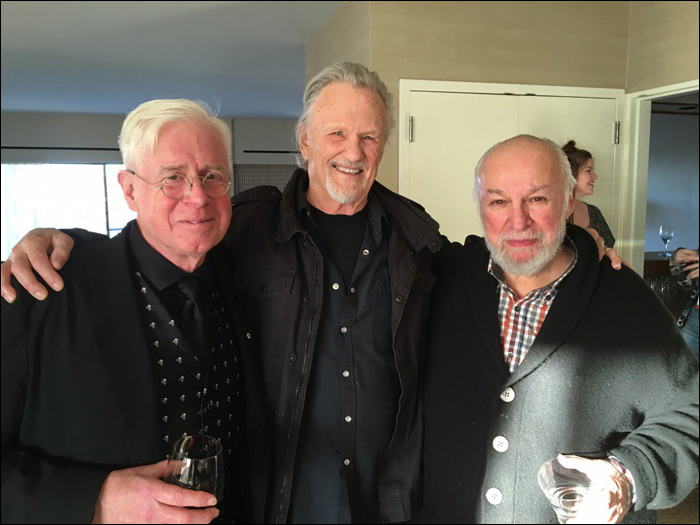
Bruce Cockburn - Kris Kristofferson - Bernie Finkelstein - AFI People's Voice Award 2017
This page is part of The Cockburn Project, a unique website that exists to document the work of Canadian singer-songwriter and musician Bruce Cockburn. The Project archives self-commentary by Cockburn on his songs and music, and supplements this core part of the website with news, tour dates, and other current information.